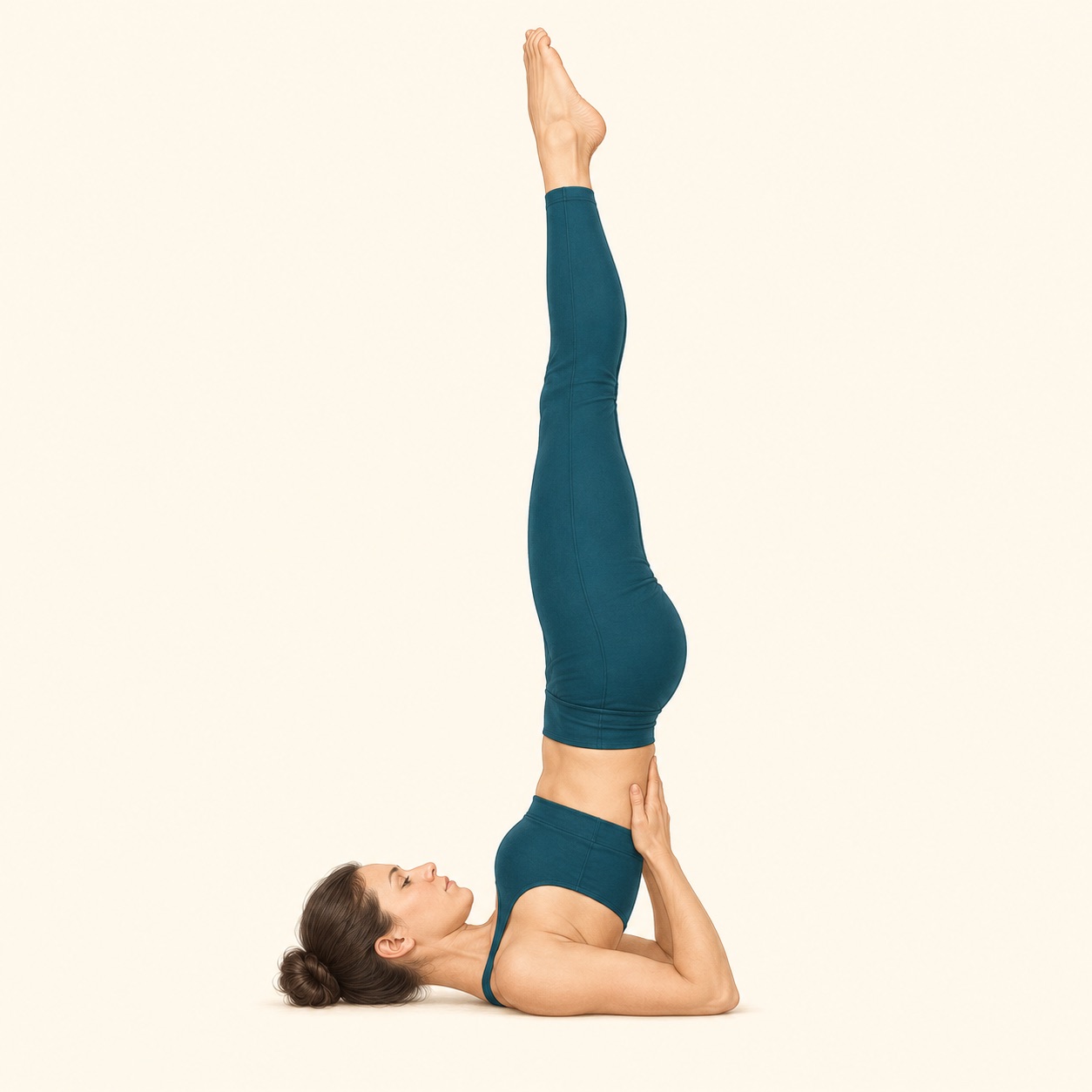
How to practice Shoulderstand
- Lie down and lift the legs and hips overhead.
- Place hands on the back with elbows grounded.
- Stack the hips over the shoulders without turning the head.
- Extend the legs upward while keeping weight off the neck.
Practice tips
- Use folded blankets under the shoulders.
- Learn with an experienced teacher.
Practice note: Avoid without guidance if you have neck, eye, blood-pressure or balance concerns.
Understanding Shoulderstand
Shoulderstand, or Salamba Sarvangasana, is an advanced supported inversion. Body weight belongs across the shoulders and upper arms, not on the cervical spine. Folded blankets, a wall and careful instruction are commonly used to create appropriate space for the neck.
Is Shoulderstand appropriate for beginners?
It is generally better learned after foundational shoulder and inversion work with an experienced teacher. Supported alternatives such as Legs Up the Wall may be more appropriate when supervision or neck-safe setup is unavailable.
Common practice points
- Keep pressure away from the cervical spine.
- Use a wall and qualified supervision while learning.
- Exit immediately if the neck, head or vision feels uncomfortable.
Prepare and progress
Review the steps before entering the pose, use the suggested modifications early, and leave enough energy for a controlled exit.
Useful preparations
Progress is not measured by how closely a pose matches a photograph. Comfort, breathing and control are more useful guides.